
Author Archives: FHA
The New Inverted Food Pyramid
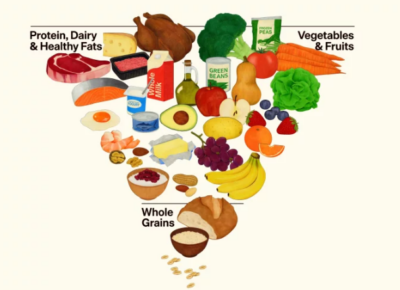
Yesterday the government announced a new “inverted” food pyramid which looks different than those in the past and upends some previous ideas that were promoted about health. HHS Secretary Robert Kennedy said “We are ending the war against saturated fat” and calling for an end to policies that promote highly refined foods that are harmful to health.
Take a look at the new food pyramid:
Here are 3 important things to note about this new guidance:
1) Refined foods, sugars and chemicals are completely removed. Not recommended at all. I like that.
2) Protein, healthy fats, vegetables and fruits dominate.
3) Grains are minimized, and only whole grains are recommended.
One pattern I also notice is that lower glycemic index foods are stressed over high glycemic index foods. Generally the lower on this inverted pyramid you go, the higher the GI is for foods shown.
While there will certainly be debate about particulars, I think this new advice generally keeps in line with their idea of promoting the consumption of real foods to promote health. When introducing these guidelines, Kennedy and Agriculture Secretary Brooke Rollins called for a “dramatic reduction” in the consumption of “highly processed foods laden with refined carbohydrates, added sugars, excess sodium, unhealthy fats, and chemical additives.”
While Kennedy and Rollins are keen on removing saturated fat as a villain, other health experts don’t agree. The saturated fat and cholesterol hypothesis has been entrenched in medicine for a long time. Personally I feel that the consumption of refined, inflammatory foods is a far bigger concern. I like the idea of only including whole real foods, though I generally do not promote the consumption of dairy. While it does contain many nutrients, it is not a natural food for adult mammals. In my practice and through food sensitivity testing I find that dairy and gluten are the 2 most inflammatory ‘real’ foods’ that we consume. Patients generally exhibit better health when they eliminate these. Very often people report losing dramatic weight when just these 2 foods are removed.
As a quantitative guide, I recommend to my patients at Functional Health & Acupuncture Institute that at least half of what we eat should be vegetables and fruits. These are most important for keeping a low inflammation diet that has adequate fiber. This is crucial to feeding our gut microbiome and promoting a strong immune system.
Does Tylenol Cause Autism?

A few weeks ago, The US government came out with guidance suggesting that pregnant women or young children not take Tylenol (acetaminophen) because of evidence that it may promote autism. This caused a bit of a stir in the media well, because including medical opinions today, everything becomes intertwined with politics.
Regardless of that, it’s worth looking at evidence to see if there really is a connection or not.
In a functional medicine approach to health and here at Functional Health & Acupuncture Institute, we are always looking for root causes of chronic health conditions. Over the last 7-10 years I have taken a number of certification courses in different functional medicine specialties, including an Autism Mastery course and Childhood Development Disorders. The idea that there is a connection between Tylenol use and autism is nothing new.
William Shaw, Director of Great Plains Laboratory (now Mosaic) wrote a paper in 2013 Journal of Restorative Medicine discussing the increased use of Tylenol starting in the 80s and the correlation with the rise in autism and asthma. Tylenol use increased when aspirin stopped being recommended for children due to a concern of another condition, Reye’s Syndrome. Doctors also would sometimes recommend giving children Tylenol before vaccines to mitigate any fever reactions after receiving the vaccines.
Correlation does not equal causation, but when there is a correlation, good science demands that this be considered by looking at available evidence. At that time, conclusions were that there is definitely a connection between increased use of Tylenol and the rise in both autism and asthma in children, but more research was needed to further understand this issue. While the rates of autism do appear to rise and fall with acetaminophen use, and some countries that do not have OTC availability of acetaminophen have very low rates of autism, this alone does not confirm causation.
Basically, the scientific findings about the metabolic effect of Tylenol indicate that vulnerable populations have defective detox pathways (called sulfation pathways). This defect causes the overproduction of toxic metabolites when there is overconsumption of acetaminophen that further impairs the body’s ability to clear toxic chemicals. So there may be a genetic predisposition to not handling acetaminophen and we know that some genetic tests can show an individual does not process this well. Acetaminophen also is known to deplete glutathione, our most important antioxidant and detoxifier. By depleting glutathione, acetaminophen weakens our ability to combat oxidative stress and free radicals which promote inflammation, including neuroinflammation. Together, this causes a negative impact on certain brain neurons that are associated with balance, autism, MS and other neurological disorders.
My conclusion is that in a vulnerable population, acetaminophen may be a problem. But without universal genetic testing, it can be challenging to know who is vulnerable. There is also a more well accepted connection between Tylenol use and rates of childhood asthma, but the mechanisms of impact are similar to those believed to be in play with autism.
For children, consider NOT giving Tylenol (or NSAIDS) prophylactically before vaccines. Children may be able to use ibuprofen safely, but for pregnant women this is more of a conundrum, as ibuprofen, and perhaps even aspirin, are not recommended during pregnancy. In these cases, consider acupuncture and relaxation techniques as good alternatives for pain management.