
Dry Needling
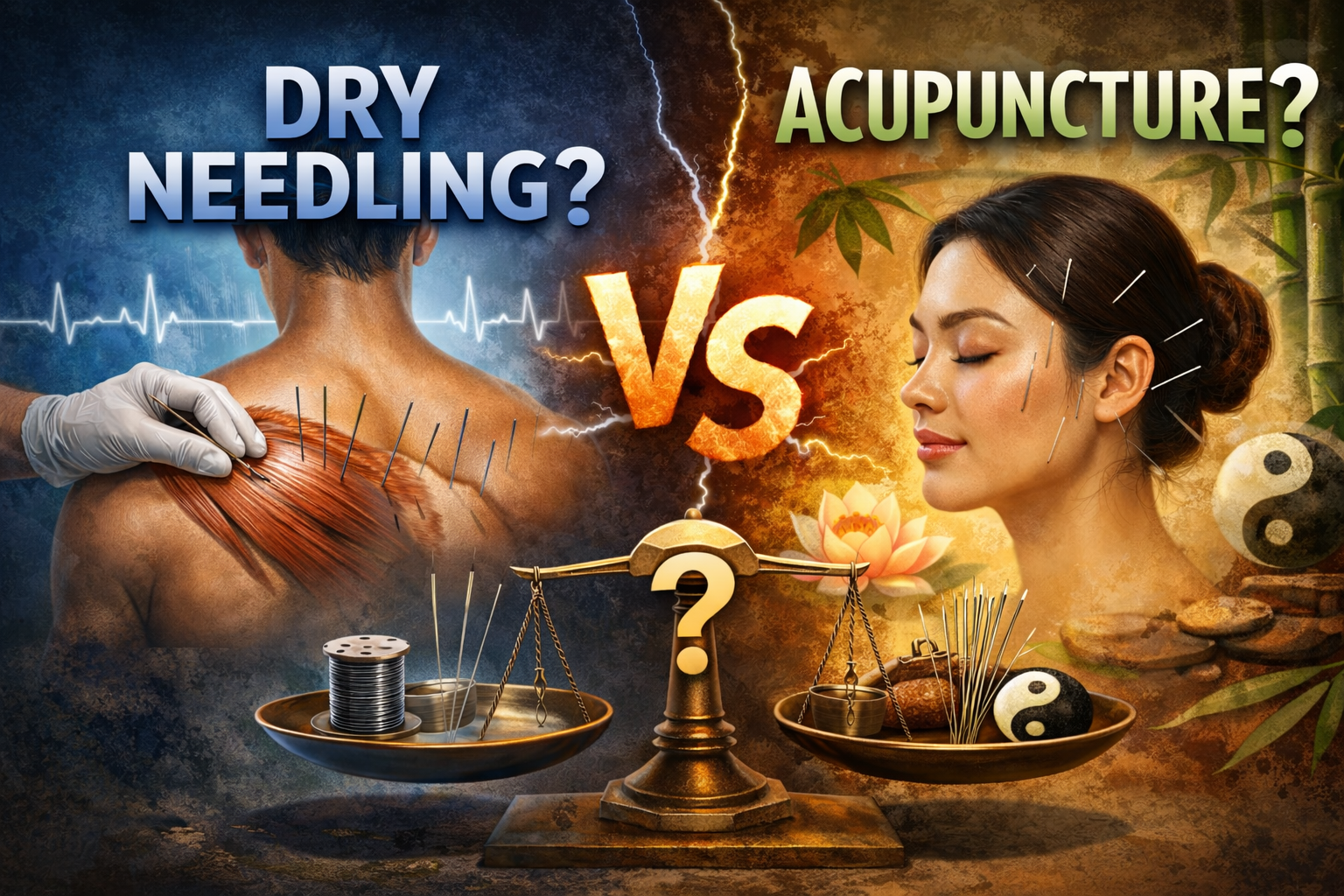
If you’ve been dealing with muscle pain, tightness, or a stubborn injury, you’ve probably heard about dry needling. It’s often promoted as a cutting‑edge solution for pain relief, especially in sports and orthopedic settings. Many patients now ask the same question: Should I choose dry needling or acupuncture?
As a licensed acupuncturist trained in multiple styles of acupuncture, including Orthopedic and Sports Acupuncture, I think this question deserves a bit more context. Not because dry needling doesn’t work—but because it’s often misunderstood.
What Is Dry Needling?
Dry needling, also known as trigger point needling, focuses on inserting thin needles into tight, painful areas of muscle known as trigger points. This can help reduce muscle tension, improve circulation, and temporarily relieve pain. What’s rarely explained, however, is that this technique is not new—and it isn’t separate from acupuncture.
In Chinese Medicine, these same tender points have been recognized for centuries and are called Ah‑Shi points, which roughly translates to “there it is.” These are areas that reproduce pain when palpated and signal underlying dysfunction. Treating Ah‑Shi points with needles has always been part of acupuncture practice. From an acupuncturist’s perspective, dry needling is simply one technique extracted from a much broader medical system.
Acupuncture is not a single method—it is a comprehensive approach to health with thousands of years of clinical refinement. Depending on the practitioner’s training, acupuncture may include traditional meridian-based treatment, orthopedic and sports-focused techniques, trigger point work, electro-acupuncture, and more. Importantly, acupuncture also involves diagnosis: understanding why pain exists, not just where it shows up. However, acupuncturists trained in orthopedic or sports acupuncture techniques will, as part of their evaluation, manually test muscles, identify which tissues are truly involved, and then tailor the local needling portion of treatment to address those exact areas—while still treating the broader patterns contributing to pain.
This is where the biggest difference lies. Dry needling is symptom-focused, addressing tight muscles in isolation. Acupuncture looks at the nervous system, circulation, inflammation, stress, recovery capacity, and underlying patterns that contribute to pain.
For acute issues, trigger point work alone may feel helpful. For recurring or chronic problems, addressing the full picture often leads to longer-lasting results.
The needles used in dry needling and acupuncture are usually physically identical. The real distinction is the depth of training and the framework guiding their use. Licensed acupuncturists complete thousands of hours of education in anatomy, safety, diagnosis, and needling techniques—far beyond learning a single method.
So is dry needling “bad”? Not at all. It can be useful when applied appropriately. But it’s important to understand that it represents only a small piece of what acupuncture already offers.
If you’re drawn to dry needling, you may actually be looking for a more comprehensive approach to pain and recovery—one that acupuncture has been providing all along.